
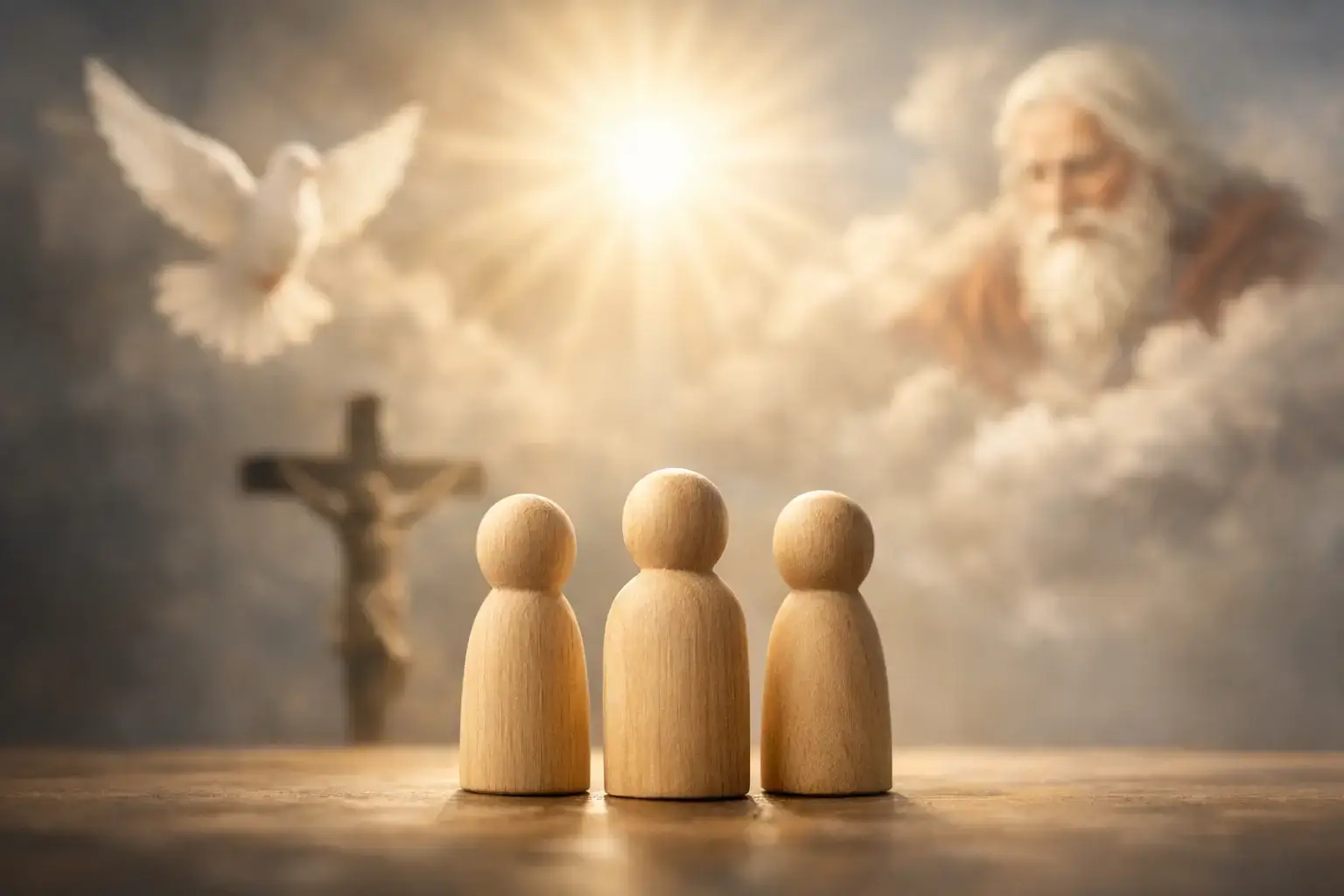
If you have ever asked what is a person in Trinitarian theology, you are really asking how Christians speak truthfully about God without reducing him to something smaller than he is. It is not a cold or abstract question. The way we understand the Father, the Son and the Holy Spirit shapes prayer, worship, discipleship and the way we receive the grace of God in everyday life.
For many people, the word person suggests an individual human being – someone separate from everyone else, with their own body, mind and life story. In Trinitarian theology, however, the word person does not mean three separate beings who happen to work together closely. It is a careful way of saying that the Father, the Son and the Holy Spirit are truly distinct from one another, yet they are not divided. They are one God.
What is a person in Trinitarian theology?
In Trinitarian theology, a person is not a separate part of God, nor one role that God plays at different times. A person is a real, eternal distinction within the one being of God. The Father is not the Son. The Son is not the Spirit. The Spirit is not the Father. Yet each is fully and completely God, sharing the one divine being.
That language matters because Scripture speaks this way. The Father sends the Son. The Son prays to the Father. The Holy Spirit is sent by the Father and the Son, and draws us into the life of God. These are not just different masks worn by one actor. They are living relations of love and communion within the one God who has made himself known to us.
This is why Christians confess one God in three persons. We are trying to honour all that God has revealed, without flattening the mystery into something easier but less faithful.
Why the word person can be confusing
The difficulty is that our everyday use of person comes with modern assumptions. We often think of persons as separate centres of existence. If we carry that meaning straight into the doctrine of the Trinity, we may imagine three gods. That is not the Christian confession.
At the same time, if we avoid real distinction between Father, Son and Spirit, we end up speaking as if God is one person appearing in three different ways. That also misses the biblical witness. Trinitarian theology holds both truths together – distinction and unity.
So when theologians use the word person, they are not saying God is like a committee of three members. They are saying that within the one life of God there is eternal relationship. The Father, Son and Spirit are distinct in relation, not divided in being.
That may still feel stretching, and that is understandable. God is not less than human language can express, but he is certainly more. Christian theology uses words carefully, while also admitting that God cannot be boxed in by our categories.
The Father, Son and Spirit are distinct
The Father is eternally Father, the Son is eternally Son, and the Holy Spirit is eternally Spirit. These are not temporary jobs or changing appearances. The distinctions are real and eternal.
We see this clearly in the life of Jesus. At his baptism, the Son stands in the water, the Spirit descends like a dove, and the Father speaks his delight. In the Gospels, Jesus speaks of his Father with intimacy and obedience. He promises the Holy Spirit, who will comfort, guide and bear witness to him. The relationships are personal, active and filled with love.
This means God’s life is not solitary. At the heart of reality is not loneliness, but communion. The God revealed in Jesus Christ is not distant or self-contained. He is eternally living in love as Father, Son and Spirit.
One God, not three gods
If the persons are distinct, what keeps Christian faith from slipping into belief in three gods? The answer is that the three persons share one divine being, one will, one power and one glory. The Father, Son and Spirit are not similar gods. They are the one God.
This is one of those places where precision matters. Christians do not believe that the Father is one-third of God, the Son another third, and the Spirit the remaining third. Nor do we believe that one person is more divine than another. Each person is wholly God.
There is mystery here, but not contradiction. We are not saying God is one person and three persons in the same sense. We are saying God is one in being and three in person. That distinction helps us speak faithfully, even if it does not remove every question.
What a person in Trinitarian theology tells us about God’s character
This teaching is not preserved merely to protect a formula. It tells us something beautiful about who God is. If God is eternally Father, Son and Spirit, then relationship belongs to God’s very being. Love is not an afterthought. God did not need to create in order to become loving. Love is who he is.
That matters for Christian faith. When we hear that God is gracious, merciful and faithful, we are not hearing descriptions of a distant force. We are hearing the heart of the triune God. The Father loves the Son in the Spirit. The Son loves the Father and shares his life with us. The Spirit pours God’s love into our hearts and brings us into fellowship with Christ.
For people seeking belonging, this is deeply comforting. The God who meets us in the gospel is not reluctant or divided within himself. The saving work of God comes from the united love of Father, Son and Spirit.
Why this matters for worship and discipleship
A Trinitarian understanding of God shapes the whole life of the church. We pray to the Father, through the Son, in the Holy Spirit. We are baptised into the name of the Father and of the Son and of the Holy Spirit. We grow as disciples by sharing in the Son’s relationship with the Father through the Spirit.
This means Christian worship is more than a religious routine. It is participation in the life and love of the triune God. Our songs, prayers, Scripture reading and fellowship are not attempts to climb our way up to God. They are responses to the God who has already come near in Jesus Christ.
It also shapes community life. If God’s own being is communion, then the church is called to reflect that grace-filled life in its relationships. We do not create unity by force or performance. We receive it as a gift from the God who gathers us into one body.
For that reason, Trinitarian theology is never just for textbooks. It belongs in ordinary faith, hope and everyday life. It teaches us that grace is personal, prayer is relational, and Christian community is rooted in the very life of God.
Speaking carefully, trusting humbly
When people ask what is a person in Trinitarian theology, they are often hoping for a simple sentence. A simple sentence can help, but it should not make the truth smaller than it is. The clearest answer is this: a person in Trinitarian theology is a real, eternal distinction within the one God – Father, Son and Holy Spirit – each fully God, never separated, always one.
There is a place here for humility. The Trinity is not a puzzle we master. It is the living God who reveals himself and invites us to know him. Some questions can be answered plainly. Others lead us to worship. Both are good gifts.
In a church community shaped by grace, this truth becomes more than doctrine on a page. It becomes a source of assurance, reverence and joy. We come to see that salvation is not merely help from God, but sharing in the life of the Father through the Son in the Holy Spirit. That is the heart of Christian faith, and it is good news for every person who longs to know they are welcomed, loved and drawn into the life of God.