
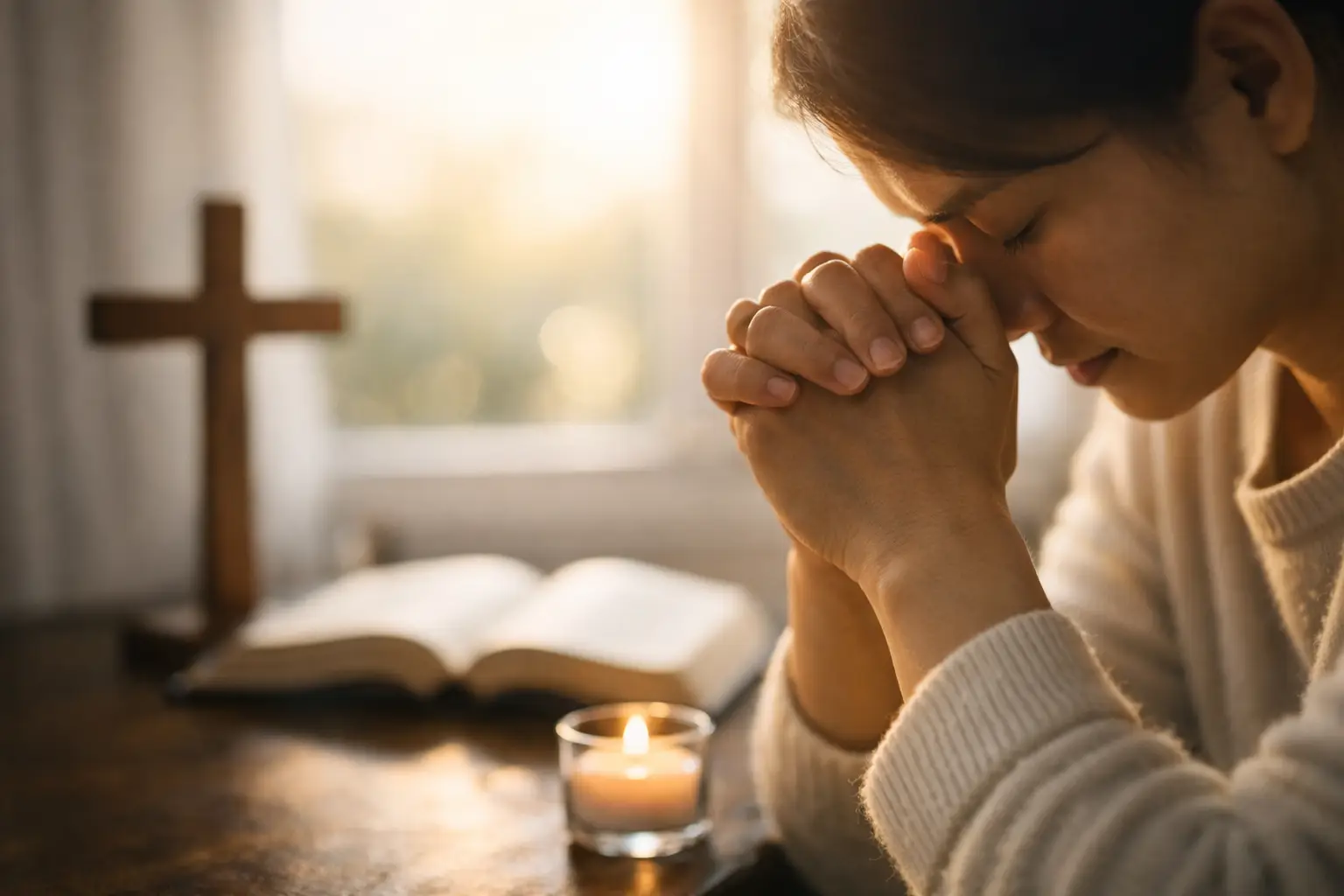
Prayer is often most needed when words are hardest to find: in a quiet kitchen before the day begins, beside a hospital bed, on the commute home, or in the middle of deep gratitude. So, what is prayer? At its heart, prayer is our response to the God who has already drawn near to us in Jesus Christ. It is an honest, grace-filled relationship with God – speaking, listening, trusting, giving thanks, asking for help and resting in his love.
Prayer is not a religious performance for people who have the right vocabulary. It is a gift. Because God is gracious, we do not begin prayer by trying to earn his attention. We come to the Father through the Son and in the Holy Spirit, welcomed as people God knows and loves.
What Is Prayer in Christian Faith?
Prayer is communion with the triune God. Christians pray to the Father, through Jesus Christ, in the power and presence of the Holy Spirit. This does not mean prayer needs to sound formal or complicated. It means that our confidence rests not in how well we pray, but in who God is and what Jesus has done for us.
Jesus shows us this relationship throughout the Gospels. He prayed in times of ministry, before significant decisions, in sorrow and in thanksgiving. He also taught his followers to pray simply and trustingly: to honour God, seek his kingdom, ask for daily bread, receive forgiveness and look to him for help in temptation.
The Lord’s Prayer remains a wise pattern for Christian prayer because it forms our hearts as well as our words. It turns us towards God before turning us towards our needs. It teaches us to ask for what is necessary today, to extend forgiveness and to desire God’s good purposes in the world. Prayer is not a way of controlling God. It is a way of participating more deeply in his loving will.
Prayer Begins With God’s Grace
Many people hesitate to pray because they feel distracted, uncertain, disappointed or unworthy. Yet prayer is not reserved for the spiritually impressive. The Psalms give us language for the full range of human life: joy, fear, confession, lament, hope and praise. God does not ask us to hide what is real before we come to him.
We can bring God our unanswered questions as well as our clear convictions. We can tell him when we are weary, when a relationship is strained, when work feels uncertain or when we simply do not know what to say. Honest prayer is not a failure of faith. It is often an expression of faith, because it brings our real lives into God’s presence rather than carrying them alone.
At times, prayer may feel warm and close. At other times, it may feel quiet or dry. Feelings matter, but they are not the measure of whether God is listening. Christian faith rests on God’s faithfulness. The Holy Spirit helps us in our weakness, including when our prayers are little more than a sigh, a tear or a repeated sentence: “Lord, have mercy.”
Prayer Is More Than Asking
Asking God for help is a meaningful part of prayer. Jesus invites us to bring our needs to the Father, and there is no concern too small or too heavy to place before him. We may pray for wisdom, healing, daily provision, courage, reconciliation or guidance.
But prayer is wider than a list of requests. It includes adoration, when we recognise God’s goodness; confession, when we turn again towards his mercy; thanksgiving, when we notice his gifts; and intercession, when we carry the needs of others before God. These movements do not need to become a rigid formula. They simply help us remember that prayer is a living relationship, not a task to complete.
Listening also belongs in prayer. Listening does not usually mean waiting for dramatic words or certain signs. Often it means becoming still enough to receive Scripture, to notice what the Spirit may be bringing to our attention, and to respond with humility and obedience. God will never lead us away from the character of Jesus revealed in Scripture.
Prayer Changes Us as We Trust God
Prayer does not guarantee that life will unfold as we expect. Christians pray because God is loving and present, not because prayer is a method for securing every desired outcome. There are seasons when we receive a clear answer, and seasons when patience, wisdom and support from others are needed.
Even where circumstances remain difficult, prayer can reshape us. It teaches dependence rather than self-reliance, gratitude rather than entitlement, and hope rather than despair. As we bring our lives before God, we learn again that we are not alone and that our future is held by Jesus.
This is one reason regular prayer matters. It is less like making an occasional emergency call and more like nurturing a relationship. Short prayers throughout the day can be deeply meaningful: giving thanks before a meal, asking for calm before a challenging conversation, or placing a worry in God’s hands before sleep. Longer times of prayer also have their place. The right rhythm depends on a person’s season of life, responsibilities and capacity. Faithfulness is not measured by length.
How Can I Begin to Pray?
You can begin where you are, with ordinary words. Choose a quiet moment, though prayer is possible anywhere. Take a breath and remember that God is already present. Then speak honestly.
You might begin, “Father, thank you that you know me and love me.” Name what is on your heart. Ask for what you need. Pray for someone else. Read a short passage of Scripture and let its words guide your response. Then leave a little space to be still before God.
If words do not come, a simple prayer can be enough: “Jesus, I trust you. Help me today.” Repeating a prayer like this is not empty when it comes from a sincere heart. It can become a steady reminder of God’s nearness in the midst of a busy day.
It can also help to write prayers in a journal, use the Psalms, or pray while walking along a familiar path. Some people find that a regular time and place supports their practice; others need to pray in brief moments around shift work, caring responsibilities or daily travel. There is freedom here. The goal is not to copy someone else’s pattern but to make room to meet with God.
Prayer Belongs to the Life of the Church
Prayer is personal, but it is not meant to be private only. When Christians gather for worship, pray for one another and bring the needs of their neighbourhood before God, they express their shared belonging in Christ. We are reminded that faith is not something we carry by ourselves.
Praying with others can be especially helpful when our own faith feels weak. A trusted Christian community can listen without judgement, offer practical care and pray with quiet confidence in God’s goodness. In this way, prayer strengthens the bonds of hospitality, service and hope that shape local church life.
At Grace Communion International Australia, prayer is part of growing together as disciples of Jesus. It makes room for us to worship God, receive his grace and encourage one another in everyday faithfulness. Whether someone is exploring Christian faith, returning to church or seeking a community in which to grow, prayer is a place to begin – not because we have everything sorted, but because God welcomes us.
Today, you do not need perfect words or a perfect moment. Turn towards God with the truth of your heart, and trust that in Jesus Christ you are heard.