
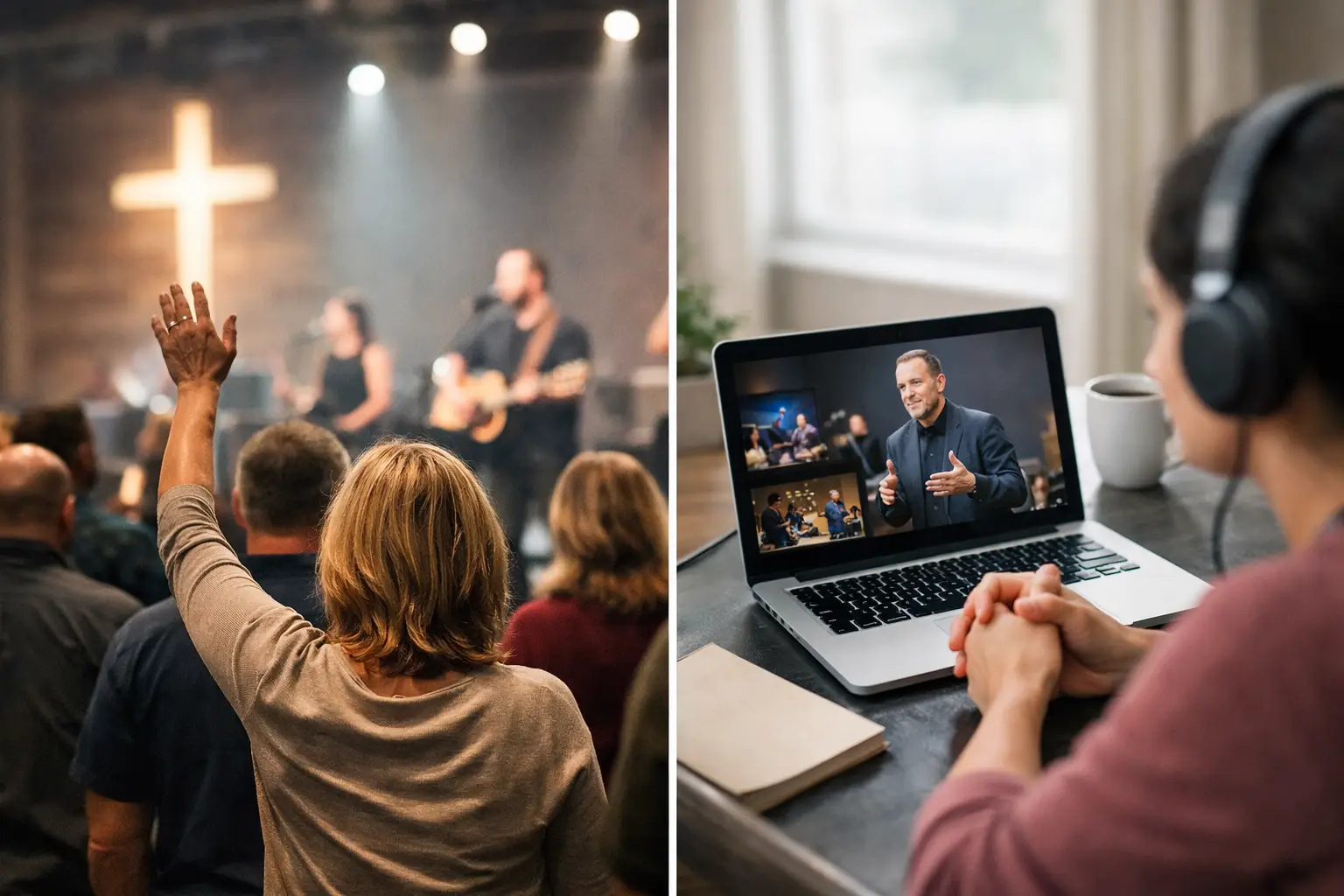
A Sunday service viewed from the lounge room can bring a familiar voice, a hymn, Scripture and prayer into a week that has felt heavy. It may be the faithful option when distance, illness, caring responsibilities or work make gathering difficult. Yet the question of in person worship versus online church is not only about convenience. It touches our longing to know Christ and to be known as part of his people.
Christ meets us by his Spirit in every place. We need not fear that a screen places us beyond his grace. At the same time, Christian faith has always drawn believers towards shared life: praying together, hearing the Word together, serving one another and learning to love people who are not exactly like us. A wise response does not dismiss online participation or idealise the gathered service. It asks what will help us receive and share the life God gives in Christ.
The church is more than a service
A Christian church community is not merely an event people attend or a programme they watch. It is a people called by God into fellowship with the Father, through the Son, in the Holy Spirit. Worship matters deeply, but it belongs within a larger life of belonging, discipleship, prayer, hospitality and service.
This Trinitarian understanding of God shapes how we see one another. God is not distant from us. In Jesus, he has drawn near, welcomed us by grace and made us part of his family. Therefore, church is not a place for people who have everything sorted. It is a community where people can grow in faith, hope and everyday life together.
That does not mean every gathering feels instantly warm or every relationship becomes close. Joining a local church can feel vulnerable, especially for someone returning to faith or attending for the first time. Still, a congregation offers something a broadcast cannot fully provide: the slow, ordinary work of becoming a community. Names are learnt. Needs are noticed. Encouragement is exchanged. People share burdens, celebrate God’s faithfulness and discover ways to serve.
What in-person worship offers
Gathering in person gives worship a shared, embodied character. We sing alongside others, listen with others, pray with others and respond together to the gospel. Even quiet moments carry meaning when we realise we are not carrying our faith alone.
For many people, the simple act of arriving matters. Setting aside time, travelling to a gathering and being present can create a helpful rhythm of attention to God. It reminds us that worship is not a private preference fitted around everything else. It is a response to the One who calls us into communion.
In-person worship also creates natural opportunities for pastoral care and discipleship. A conversation before or after the service may reveal a person who needs prayer. A newcomer can be welcomed. A question about Scripture can become the beginning of a deeper relationship. These moments cannot be forced, but they are often how a church learns to care for one another with patience and practical love.
Families, people living alone and those new to an area may especially value this kind of presence. A local congregation can become a place where different generations learn from each other and where gifts are shared for the good of all. Hospitality may be as simple as a genuine greeting, a cup of tea or making room at a table. In Christ, such small acts are never small.
Of course, in-person attendance is not a measure of anyone’s worth or spiritual maturity. Some people face real barriers. Others may need time before they feel ready to walk through a church door. Grace invites rather than pressures. The aim is not to make people feel guilty, but to help each person take a faithful next step.
Where online church can serve well
Online worship has become a meaningful doorway for many. It can allow someone to hear biblical teaching while unwell, travelling or unable to reach a congregation. It can help a person explore Christianity quietly before visiting. It can also keep people connected to a familiar church during a temporary season away.
For those who feel anxious about attending, watching online may be a gentle beginning. It gives space to listen, reflect and become familiar with a church’s worship and teaching. This should not be treated as lesser faith. God often meets people before they have found the words or confidence to introduce themselves.
Digital ministry can also extend care beyond Sunday. A message, online prayer gathering or recorded teaching may encourage someone at a difficult moment. When used thoughtfully, technology can support connection and help people remain part of the conversation of faith.
Yet watching is not always the same as participating. A person can be spiritually nourished by a message and still feel unseen. It is easy to leave a video early, remain anonymous or let worship become one more piece of content among many. Online church is most life-giving when it opens pathways towards relationship rather than replacing relationship altogether.
In person worship versus online church: a faithful question
The choice is not always either-or. A person may worship online for a season and join in person when circumstances allow. Someone may attend a local gathering regularly and use online teaching during the week. The better question is often: what kind of participation is possible now, and how can it lead towards deeper communion with God and his people?
If online worship is your current reality, consider one gentle step towards connection. You might let a church know you are watching, ask for prayer or arrange to visit when you feel ready. If you are attending in person, consider how you might notice those who are new, quiet or uncertain. A welcoming community is built as ordinary people make room for one another.
It is also helpful to examine what we seek from church. If we only seek a service that suits our preferences, we may miss the gift of being formed through others. Christian discipleship includes receiving encouragement, but it also includes learning to encourage. It means listening, forgiving, praying and using our gifts in love. These practices grow most naturally in relationships where people are present to one another over time.
Choosing a next step with grace
When looking for a church home, seek a community centred on Jesus Christ, grounded in Scripture and marked by grace. Listen for teaching that points to the love of the Father, the saving work of the Son and the renewing presence of the Holy Spirit. Notice whether people are welcomed with kindness and whether there are genuine opportunities to grow, serve and be cared for.
You do not need to decide everything after one visit. Give yourself permission to come, listen and ask questions. A healthy church community understands that trust develops gradually. It will welcome both your faith and your questions, and it will encourage you to grow at a pace shaped by grace.
Grace Communion International Australia seeks to offer this kind of Christ-centred community through local worship, pastoral relationships and discipleship. Whether you begin by watching online or by visiting a congregation, the invitation is the same: come closer to Jesus and discover that you do not have to walk the journey of faith alone.
The next faithful step may be modest: join a service, introduce yourself, ask for prayer or return next week. In every season, Christ remains present, drawing us into his love and teaching us to share that love with one another.