
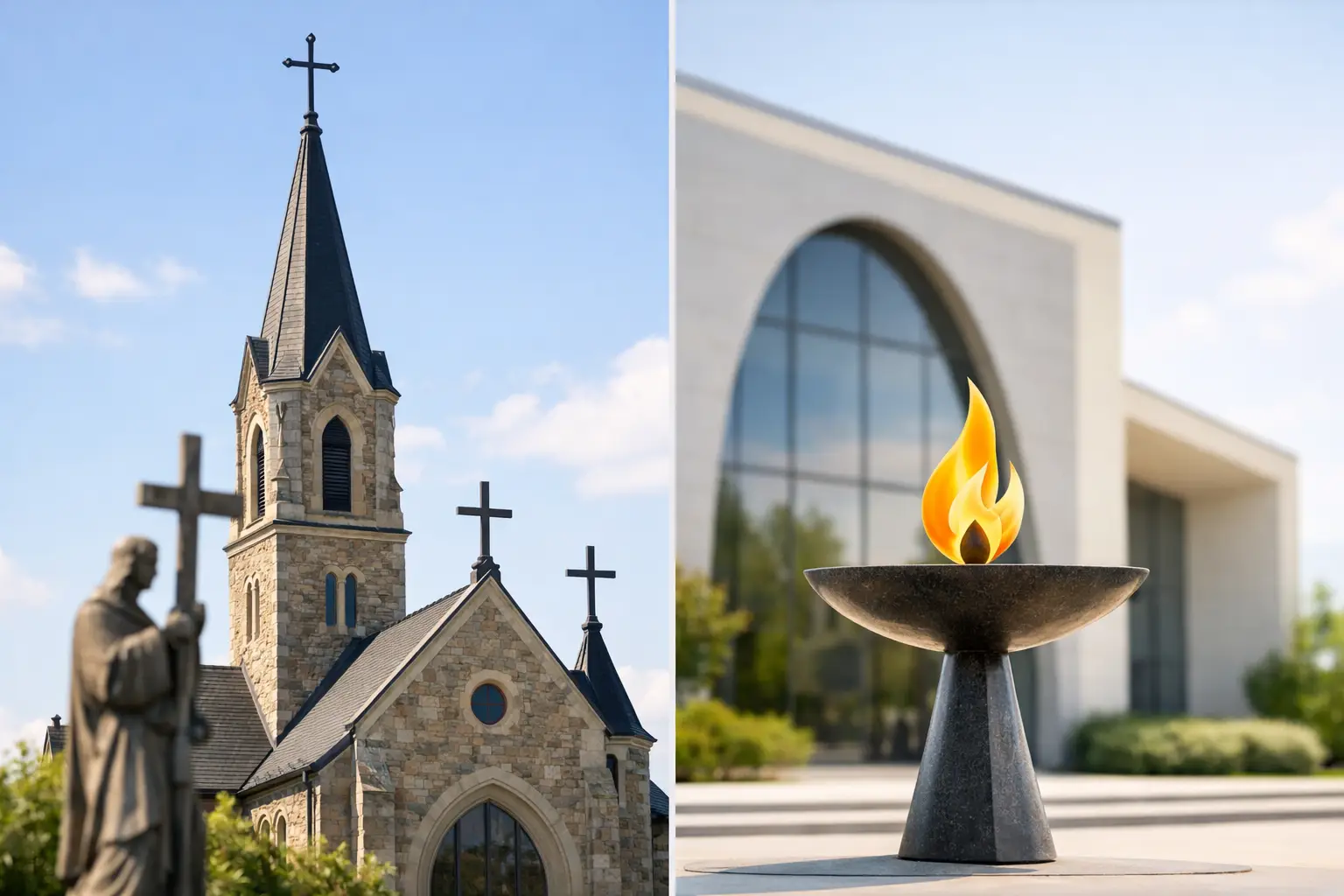
A search for a trinitarian church vs unitarian church comparison often begins with a personal question: What will this community believe about God, Jesus and the Christian life? The words can sound technical, yet they shape the prayers a church prays, the worship it offers and the way people understand grace, belonging and discipleship.
For anyone looking for a church home, clarity matters. It does not need to become a reason for hostility or a test of who is welcome to ask honest questions. It can be an invitation to listen carefully, read Scripture thoughtfully and find a community where you can grow in trust in Jesus.
What does Trinitarian mean?
A Trinitarian church confesses one God who is eternally Father, Son and Holy Spirit. Christians do not mean three separate gods, nor do they mean that one person simply changes roles at different times. The Christian confession is that God is one in being and exists eternally as three distinct persons, united in love, purpose and glory.
This understanding is rooted in the biblical witness. Jesus speaks of the Father, promises the Holy Spirit, and sends his followers to baptise in the name of the Father, the Son and the Holy Spirit. Across the New Testament, God’s saving work is described in a deeply relational way: the Father sends the Son, the Son reveals the Father, and the Spirit brings people into the life and fellowship of God.
For Trinitarian Christians, Jesus is not only a wise teacher or a specially chosen messenger. He is the eternal Son of God who became human for us. Through his life, death and resurrection, Jesus draws us into reconciliation with the Father and gives us new life through the Holy Spirit.
This is more than a formula for a statement of belief. If God’s own life is love and communion, then Christian community is shaped by welcome, service, forgiveness and mutual care. We do not create our place with God through effort. In Christ, we are received by grace.
What does Unitarian mean?
The word Unitarian emphasises the unity of God. In a Christian Unitarian setting, God is generally understood as one person rather than Father, Son and Holy Spirit in the Trinitarian sense. Jesus is commonly honoured as a central teacher, Messiah or uniquely appointed representative of God, but not confessed as fully God in the same way Trinitarian churches confess him.
The term can describe more than one kind of community. Some groups identify as Christian Unitarians and draw directly on the teachings and example of Jesus. Other communities using the Unitarian name may welcome people from many faith backgrounds, or people with no defined Christian confession. Their worship, beliefs and approach to Scripture can therefore vary considerably from one congregation to another.
That variation is worth remembering. A church name alone cannot tell you everything about its life together. If you are visiting, it is reasonable to ask what the church believes about God, Jesus, the Holy Spirit, the Bible, prayer and Christian discipleship.
Trinitarian church vs Unitarian church: the central difference
The central difference concerns the identity of God and the identity of Jesus. A Trinitarian church worships the one God as Father, Son and Holy Spirit, and confesses Jesus Christ as the divine Son who became human. A Unitarian church affirms God’s oneness without affirming the Trinity, and its understanding of Jesus will be different.
This difference reaches into the language of worship. In a Trinitarian congregation, prayers may be offered to the Father through the Son in the Holy Spirit. Songs, sermons and communion will usually centre on the saving work of Jesus and the presence of the Spirit among God’s people. Baptism is ordinarily celebrated in the name of the Father, Son and Holy Spirit.
In a Unitarian congregation, worship may focus on the one God, the moral and spiritual teaching of Jesus, shared reflection, or a broader spiritual journey. The particular shape depends on the congregation’s history and beliefs. It is best not to assume that every Unitarian community practises faith in the same way.
These are meaningful theological differences, but they need not lead to dismissiveness. Christians are called to speak truthfully with humility, remembering that every person is someone God sees and loves. A gracious conversation does not avoid conviction. It holds conviction together with respect.
Why the Trinity matters to Christian faith
For a Trinitarian Christian, the Trinity helps us see the fullness of the good news. The Father’s love is not distant or abstract. It is made known in Jesus Christ. Jesus does not merely point the way towards God from afar. He brings us to the Father. The Holy Spirit is not simply an influence or an idea, but God’s living presence, renewing hearts and forming believers into the likeness of Christ.
This gives everyday faith a personal and hopeful shape. When we pray, we come to a loving Father. When we feel weak or uncertain, we look to Jesus, who knows our humanity and remains faithful. When we need wisdom, courage or comfort, we trust the Holy Spirit to work in and among us.
A Trinitarian understanding also guards the truth that salvation begins with God’s grace. The Father, Son and Spirit are not competing for our attention. God is united in his loving purpose to reconcile, heal and restore. Christian discipleship becomes a response to that gift, not an anxious attempt to earn acceptance.
What this means for church life
Beliefs are lived out in ordinary church life. They influence how a congregation welcomes newcomers, teaches Scripture, cares for one another and serves its local community. A healthy church will not use theological language merely to sound certain. It will help people see how faith in the triune God shapes prayer, relationships, work, suffering and hope.
In a Trinitarian church, worship is an opportunity to participate in the life God shares with us. Gathering with others reminds us that faith is not a private project. We learn to receive encouragement, offer our gifts and walk alongside people in different seasons of life. There is room to ask questions, to grow slowly and to be met with patience.
Of course, no congregation lives perfectly into its beliefs. Every church is made up of people still being formed by grace. Look for a community where Jesus is at the centre, the Scriptures are treated with care, prayer is genuine, and people are encouraged towards love, humility and service.
How to discern a church community
If you are seeking a local Christian church, begin with simple, open questions. Ask how the church describes God, who it says Jesus is, and how it understands the work of the Holy Spirit. Ask what happens in worship, how people are supported in times of need, and how new people can become part of the community.
It can also help to attend more than once. A first visit gives an impression, but community is often seen over time. Notice whether hospitality is offered without pressure. Listen for whether the gospel is presented as good news of grace. Consider whether the church creates space for mature discipleship as well as honest questions.
For those seeking a Trinitarian Christian community, it is appropriate to look for a church that clearly confesses the Father, Son and Holy Spirit and centres its worship and teaching on Jesus Christ. Grace Communion International Australia seeks to be such a community: grounded in the grace of God, open in relationship and committed to growing together as followers of Jesus.
A place to grow in grace
The difference between Trinitarian and Unitarian belief is significant, particularly in how God and Jesus are understood. Yet the purpose of seeking clarity is not to win an argument. It is to know the God revealed in Jesus more deeply and to find a faithful community in which that knowledge becomes love in action.
As you take a next step, bring your questions honestly to God. A welcoming church community should make room for your journey while pointing you, again and again, to the grace, hope and faithful presence of Jesus.